
Key Takeaways
- Foundation waterproofing manages moisture but structural problems require structural solutions.
- The most common causes of basement leaks are hydrostatic pressure, soil movement, and aging concrete.
- Interior and exterior waterproofing systems each have their role; neither is a permanent fix for a compromised foundation.
- Foundation sealing, drainage membranes, and sump systems work best as part of a planned, integrated approach.
- When a foundation shows signs of movement, settling, or major cracking, underpinning is the structural answer.
- Hydraulic cement and crack injections stop active leaks; they do not address the root cause.
- Lot grading and downspout drainage are among the most overlooked and most preventable causes of basement water infiltration.
- Choosing the right contractor matters as much as choosing the right repair method.

Water in your basement is never just a cosmetic problem. Whether you’re seeing a slow seep along the base of a wall, white mineral deposits on the concrete, or standing water after a heavy rain, moisture in a basement signals a breakdown somewhere in your home’s first line of defence: the foundation. Understanding what’s happening, why it’s happening, and what the real solutions look like is the difference between a homeowner who patches the same crack every spring and one who solves the problem for good.
This guide covers everything from the basics of foundation waterproofing to the full spectrum of repair methods, materials, and when a deeper structural solution is needed. Whether you own a 1970s bungalow in Scarborough, a detached home in Vaughan, or a semi in Etobicoke, the principles are the same and the stakes are equally high.
What is a water proofing foundation and why is it essential for protecting your home?
Foundation waterproofing is the system of materials, coatings, drainage layers, and structural measures that prevent water from penetrating the below-grade walls and floor of a home.
It is not a single product or a single repair, it is an integrated approach that accounts for where water is coming from, how it is moving through soil and concrete, and where it needs to be redirected.
In Ontario, where freeze-thaw cycles are aggressive and clay-heavy soils in the GTA retain and expand with moisture, foundation waterproofing is especially critical. The soil around a basement foundation absorbs rainfall and snowmelt, then exerts hydrostatic pressure, a lateral and downward force directly against the foundation walls. Older concrete, which is porous by nature, is particularly vulnerable.
How moisture enters a foundation
Water finds its way into basements through several pathways:
Why waterproofing matters beyond the basement
A damp basement does more than ruin storage. Persistent moisture leads to mold growth, which spreads through HVAC systems. It degrades structural wood components like sill plates and joists. It reduces indoor air quality throughout the home. And in Ontario’s real estate market, evidence of water damage or foundation issues is one of the fastest ways to reduce property value and complicate a sale.
The Canada Mortgage and Housing Corporation (CMHC) identifies moisture infiltration as one of the leading causes of building envelope failure in Canadian residential construction. Left unaddressed, it becomes far more expensive to fix.
Waterproofing and structural work done before finishing is the only way to protect your investment. Explore how underpinning and foundation preparation fit into a full basement renovation.
What are the most common causes of a leaking foundation in residential homes?
Most residential foundation leaks in Toronto and GTA trace back to 1 of 5 root causes: hydrostatic pressure, soil expansion and movement, poor drainage around the home, aging or deteriorating concrete, and construction deficiencies.
Hydrostatic pressure
When the soil around a foundation becomes saturated after a spring thaw, a heavy rainfall event, or during snowmelt water accumulates faster than it can drain. This creates hydrostatic pressure: a force that pushes water through any available opening in the foundation. In areas like North York and Markham where lots have been regraded over decades, original drainage patterns may no longer function as intended.
Soil expansion in clay-heavy GTA soils
Southern Ontario’s clay-rich soil expands significantly when wet and contracts when dry. This seasonal movement exerts lateral pressure against foundation walls, causing cracking over time particularly in Richmond Hill, Aurora, and Newmarket, where dense residential development has altered lot drainage patterns.
Poor lot grading and gutter drainage
Water that is not directed away from the home correctly will pool around the foundation. This is covered in its own section below, as it is one of the most preventable causes of basement water infiltration.
Aging concrete and construction deficiencies
Homes built in the 1960s through 1980s a significant portion of the GTA’s housing stock in cities like Mississauga, Etobicoke, and Scarborough often have poured concrete or concrete block foundations with minimal waterproofing by today’s standards. Original damp-proofing coatings (typically a thin tar-based coating applied at time of construction) break down over time and offer little resistance to hydrostatic pressure.
| Cause | Common Signs | GTA Risk Factors |
|---|---|---|
| Hydrostatic pressure | Seeping walls, floor cracks, wet cove joint | Clay soils, flat lots, dense development |
| Soil expansion | Bowing walls, horizontal cracks, stair-step cracks in block | Southern Ontario clay composition |
| Poor drainage | Seasonal leaks after rain or snowmelt | Negative grading, old downspouts |
| Aging concrete | Efflorescence, seepage through wall face | Homes 30 – 60 years old |
| Construction defects | Leaks at penetrations, corners, window wells | Builder-era damp-proofing only |
What types of basement waterproofing systems are available for foundation protection?
Basement waterproofing systems fall into 2 broad categories: interior systems and exterior systems.
Each has distinct applications, cost implications, and limitations. Understanding both is essential before committing to any waterproofing scope.
Interior waterproofing systems
Interior waterproofing does not stop water from entering the foundation; it intercepts water that has already entered and redirects it to a sump system before it can cause damage.
Common components include:
Interior systems are generally less disruptive to install no exterior excavation required and are often less expensive upfront. They are appropriate for managing ongoing moisture in older foundations where full exterior waterproofing is cost-prohibitive. Their limitation is that they do not address the source of water entry.
Exterior waterproofing systems
Exterior waterproofing addresses the source directly by excavating around the foundation, cleaning and repairing the wall surface, applying a waterproof membrane, installing a drainage layer and weeping tile, and backfilling with clean stone. This is the most comprehensive approach and, when properly executed, provides the highest level of long-term protection.
Exterior systems are the standard in new construction. For existing homes, they involve significant excavation costs particularly in urban GTA settings where lot access may be restricted by fences, decks, or landscaping.
| System Type | How It Works | Best For | Approx. Cost (CAD |
|---|---|---|---|
| Interior drainage | Intercepts water, redirects to sump | Active seepage, older homes, budget constraints | $5,000 – $15,000 |
| Exterior membrane | Blocks water at source via membrane + drainage layer | New construction, comprehensive protection | $15,000 – $40,000+ |
| Sump pump system | Removes water collected by drainage system | All homes with interior drainage | $1,500 – $4,000 |
| Crack injection (interior) | Seals individual cracks from inside | Isolated leaks in poured concrete | $400 – $1,500 per crack |
| Exterior crack repair | Excavates and seals crack from outside | Significant structural or recurring cracks | $2,000 – $5,000 per crack |
The table compares the most common waterproofing systems by method, application, and typical cost range in the GTA. Use it as a starting point for understanding scope not as a substitute for a professional assessment, since the right system always depends on your specific foundation conditions.
For a deeper look at waterproofing options, see our complete basement waterproofing guide.
Interior vs. exterior waterproofing systems
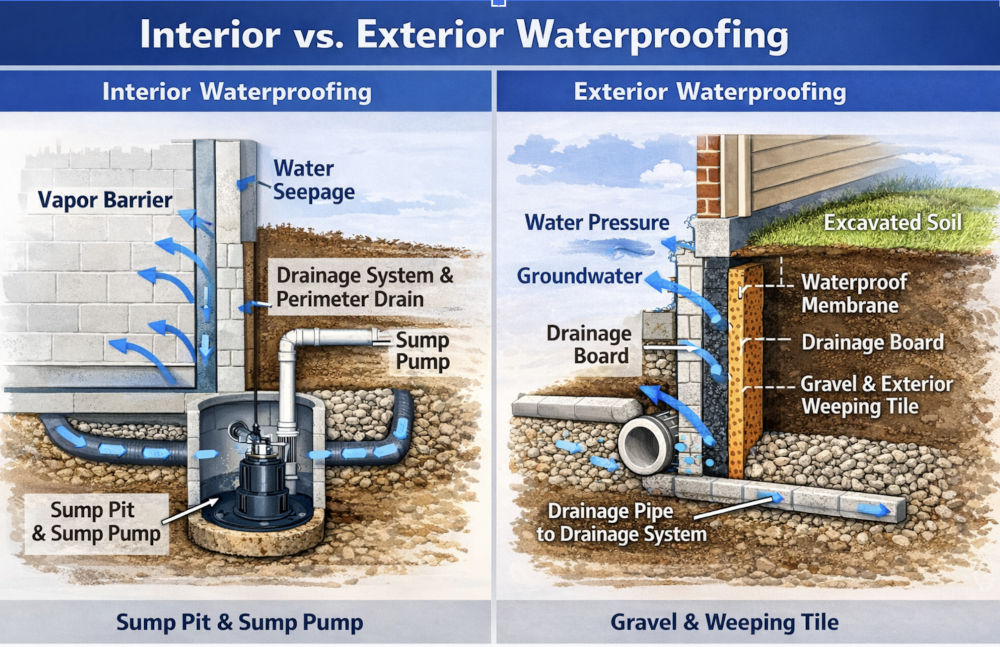
The choice between interior and exterior waterproofing is one of the most consequential decisions in any foundation moisture project and the answer depends on the source of the problem, not the cost of the solution.
Exterior waterproofing is the gold standard. By sealing the foundation wall on its outer face, applying a drainage membrane, and ensuring weeping tile properly channels water away, you are removing the moisture threat before it ever contacts your foundation. This is always the preferred approach when full excavation is feasible and the budget allows.
Interior waterproofing is a practical solution for homes where exterior excavation is not realistic because of cost, restricted lot access, mature landscaping, or attached structures. It works by accepting that some moisture will enter the wall and managing it before it causes damage. Done properly, interior drainage systems are highly effective long-term management tools. They are not a compromise on results; they are a different architectural strategy for the same outcome.
Where homeowners get into trouble is choosing interior waterproofing because it is cheaper, without confirming that the foundation is structurally sound. Interior drainage cannot stop a wall that is actively bowing, and it cannot compensate for a foundation that is settling. Structural issues must be resolved before or as part of any waterproofing scope.
Decision guide: interior vs. exterior
| Your Situation | Recommended Approach | Why |
|---|---|---|
| Active seepage, structurally sound walls | Interior drainage + sump | Cost-effective; addresses symptom at source |
| Foundation in good condition, poor exterior drainage | Exterior grading + weeping tile | Resolves cause without interior disruption |
| Full basement renovation planned | Exterior membrane + interior drainage | Best window to do both; amortises excavation cost |
| Bowing or cracking walls with movement | Structural repair first, then waterproof | Waterproofing alone will not hold a moving wall |
| New construction or full gut renovation | Exterior membrane as standard scope | Only practical time for full exterior system |
For GTA homeowners planning a full basement renovation, the renovation itself creates a natural window to do exterior waterproofing properly, excavation cost is amortised across the project, and closing walls over an unprotected foundation is a liability that shows up as callbacks and warranty claims.
How does foundation sealing help prevent water damage and basement leaks?
Foundation sealing refers to the application of waterproof coatings, membranes, or injection materials directly to the foundation surface to block moisture pathways. It is one component of a waterproofing system not a complete solution on its own, but a critical layer in any well-designed approach.
Types of sealants used in waterproofing
Different sealing materials serve different purposes:
The National Research Council of Canada’s Canadian Construction Materials Centre (CCMC) evaluates and certifies below-grade waterproofing membranes used on Canadian foundation walls. According to CCMC evaluation standards, proper selection of waterproofing materials must account for substrate condition, application environment, and hydrostatic head to achieve durable performance. Applying the wrong material in the wrong context leads to premature failure.
What waterproofing and foundation repair materials are used in modern systems?
The materials used in foundation waterproofing and repair have advanced significantly over the past two decades. Understanding their properties and appropriate applications helps homeowners ask better questions and evaluate contractor proposals critically.
Epoxy injection systems
Two-component epoxy resins cure to create a bond stronger than the surrounding concrete. Used for structural crack repairs in poured concrete foundations where the crack is stable (not actively growing). Epoxy injections restore tensile strength across the crack but do not flex — they are not appropriate for cracks that are still in active movement.
Polyurethane foam systems
Polyurethane expands on contact with water, making it ideal for sealing active wet cracks. It is flexible after curing, accommodating minor seasonal movement without re-cracking. Commonly used for cove joint repairs and hairline crack sealing. It does not restore structural strength but effectively stops water infiltration.
Waterproofing membranes
Modern exterior waterproofing membranes include rubberized asphalt sheets, spray-applied polymer coatings, and HDPE drainage composites. These provide a continuous barrier against hydrostatic pressure when properly applied to a clean, prepared foundation surface. The Canadian Standards Association (CSA) standard CSA A231.2 governs precast concrete waterproofing specifications; for in-situ applications, manufacturer specifications and Ontario Building Code requirements apply.
Crystalline admixtures and coatings
Crystalline waterproofing products contain active chemicals that react with water and cement particles to form insoluble crystals within the concrete matrix. They can be applied as a surface coating or added to concrete mixes. Unlike surface membranes, crystalline products self-seal minor cracks and re-activate when moisture is present — making them a popular choice for below-grade applications.
Hydraulic cement
Hydraulic cement is a fast-setting material used for plugging active leaks. See the dedicated section below for full application details.
| Material | Best Application | Flexibility | Structural Benefit |
|---|---|---|---|
| Epoxy resin | Structural crack sealing (dry, stable cracks) | None – rigid | Yes, restores tensile strength |
| Polyurethane foam | Active wet cracks, cove joints | High – flexible | No, sealing only |
| Hydraulic cement | Active leak plugging, spot repairs | None – rigid | Minimal |
| Rubber/polymer membrane | Exterior waterproofing systems | Moderate | No, barrier only |
| Crystalline coating | Interior/exterior surface waterproofing | Self-healing | Partial, reduces permeability |
| HDPE drainage board | Exterior drainage layer | N/A | No, drainage only |
How does lot grading and downspout drainage affect your foundation?
Poor surface drainage is one of the most common and most preventable causes of basement water infiltration in GTA homes. It is also one of the most frequently overlooked because the damage it causes accumulates gradually and is rarely visible until water appears inside.
The principle is straightforward: if water cannot drain away from the home efficiently, it saturates the soil against the foundation. That saturated soil creates the hydrostatic pressure that drives moisture through concrete walls, the cove joint, and floor slab. Improving surface drainage is often the highest-value, lowest-cost intervention available.
Lot grading

The grade or slope of the ground immediately around a foundation should fall away from the house at a minimum of 5cm over 1.5 metres (roughly 2 inches over 5 feet), as referenced in the Ontario Building Code. In practice, many GTA homes have had their lots regraded, patios added, or garden beds raised over decades, creating areas of negative grading where water flows toward rather than away from the foundation. Correcting negative grading is often a lower-cost first step before committing to full waterproofing systems.
Downspout extensions and disconnection
Eavestroughs (gutters) that empty directly at the foundation wall are a primary contributor to basement leaks. The City of Toronto’s Basement Flooding page recommends downspout extensions that carry water at least 1.8 metres (6 feet) from the foundation. In many GTA municipalities, downspout disconnection from the sanitary sewer has been mandated as a stormwater management measure.
Window wells
Basement window wells that are not properly sized, drained, or covered accumulate rainwater and direct it through window frames and the foundation wall directly at below-grade level. A window well cover and a properly sized gravel drainage base (minimum 30cm/12 inches deep) are low-cost measures that eliminate a common point of water entry.
| Surface Drainage Issue | Effect on Foundation | Typical Fix | Approx. Cost (CAD) |
|---|---|---|---|
| Negative lot grading | Directs surface runoff toward foundation | Add and compact fill; regrade perimeter | $500 – $3,000 |
| Downspout at foundation | High-volume discharge at foundation wall | Downspout extension or underground discharge | $200 – $1,000 |
| Window well without drainage | Water pools and infiltrates at window level | Gravel base + window well cover | $150 – $600 per well |
| Flat or sunken patio | Water ponds and saturates foundation soil | Regrade or relay patio surface | $1,500 – $6,000 |
When should homeowners consider structural foundation repair instead of simple waterproofing?
Not every foundation problem is a waterproofing problem. When a foundation has moved, settled, or lost structural integrity, waterproofing measures alone will not resolve the issue and in some cases, may mask it while the underlying damage worsens.
The key distinction is between a foundation that is leaking versus a foundation that is failing. A leaking foundation can be managed with waterproofing. A failing foundation requires structural intervention.
Signs that indicate structural repair is needed
| Situation | Waterproofing Sufficient? | Structural Repair Needed? |
|---|---|---|
| Hairline cracks with minor seepage | Yes, crack injection + sealing | No |
| Consistent wall seepage through porous concrete | Yes, interior drainage or exterior membrane | No |
| Horizontal wall cracks with bulging | No | Yes, wall anchors, piering, or underpinning |
| Significant settlement causing floor slope | No | Yes, underpinning or piering |
| Collapsed or severely deteriorated wall section | No | Yes, potential replacement required |
Waterproofing alone won’t fix a compromised foundation. Learn how basement underpinning addresses the structural root cause.
What foundation repair methods are used to fix basement leaks and structural damage?
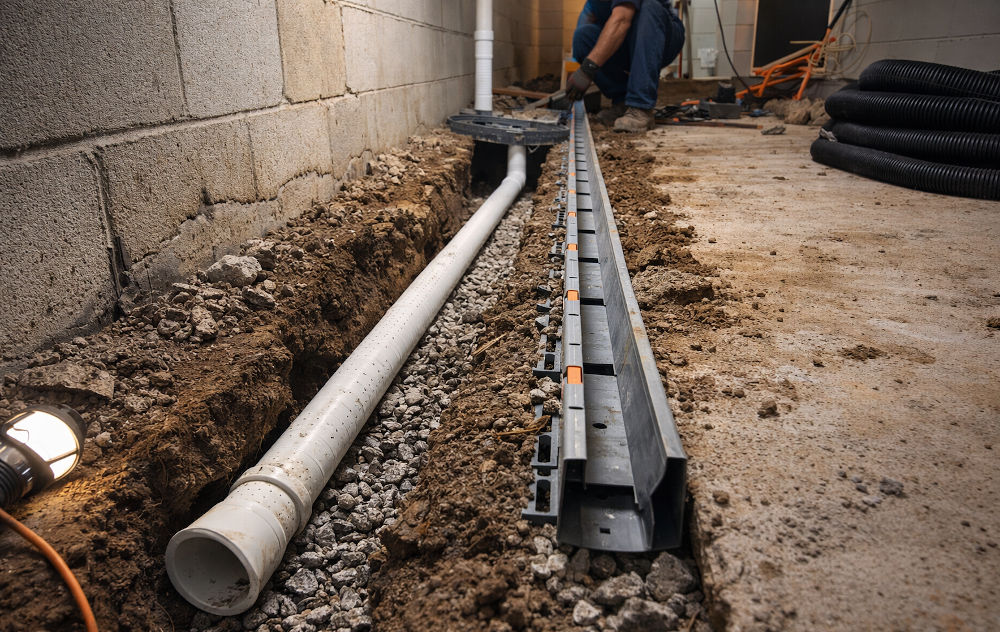
Foundation repair covers a wide range of methods, from relatively simple crack injections to complex piering and underpinning systems. The appropriate method depends on the nature of the damage, the type of foundation, and the long-term goals for the space.
Interior repair approaches
Exterior repair approaches
How does hydraulic cement foundation repair stop active water leaks in basement walls?
Hydraulic cement is a fast-setting cementitious material that expands slightly as it cures, allowing it to seal against flowing water and actively leaking cracks or holes.
Unlike standard Portland cement, hydraulic cement begins its chemical reaction on contact with water rather than air. It can be pressed into an active leak and will harden within three to five minutes, stopping water flow mechanically. The expansion during curing helps it conform to irregular crack profiles and bond against wet concrete surfaces.
Step-by-step: how hydraulic cement is applied
- The crack or hole is chiselled out to create an undercut profile wider at the back than at the face so the hardened cement is mechanically locked in place.
- The area is cleaned of loose material and any efflorescence (white mineral deposits).
- Hydraulic cement is mixed to a pliable consistency and shaped into a cone or plug.
- The plug is pressed firmly into the crack and held by hand for two to three minutes while the initial set occurs.
- After full cure (typically 24 – 48 hours), the repair is coated with a waterproof sealant or membrane to complete the barrier.
Quick patch vs. long-term repair
Hydraulic cement is a temporary or supplementary measure, not a permanent waterproofing solution. It stops the immediate water ingress but does not address hydrostatic pressure, soil conditions, or the cause of the crack. In most cases, a hydraulic cement repair is step one followed by crack injection, drainage improvement, exterior waterproofing, or underpinning as the long-term solution when foundation movement or structural instability is involved.
Using hydraulic cement as the sole response to a leaking foundation is analogous to placing a patch over a torn sail; it may hold under calm conditions but will fail under pressure. This mirrors the broader principle that applies across all crack and leak repair: patching the visible evidence does not resolve the underlying condition. In situations where settlement or structural stress contributes to the problem, underpinning provides the deeper stabilization needed to support the foundation and prevent recurring damage.
When is foundation replacement necessary for severe structural damage?
Foundation replacement – the complete removal and reconstruction of one or more foundation walls is the most intensive and costly intervention in residential structural repair. It is warranted only in cases of severe, irreversible structural deterioration that cannot be addressed through repair methods.
For most GTA homeowners with aging homes, foundation replacement is rare. More commonly, deteriorated foundations benefit from underpinning which reinforces and extends the existing footing rather than replacing the wall combined with exterior waterproofing. This approach is typically less disruptive and more cost-effective.
How can basement waterproofing and foundation repair work together to prevent recurring leaks?
The most effective approach to a dry, durable basement combines structural repair with a complete waterproofing system addressing both the cause and the pathway of water infiltration simultaneously.
When these 2 elements are treated separately or when waterproofing is applied to a structurally compromised foundation the results are typically short-lived. Water will find new pathways through an unstable foundation, and structural repairs will be compromised by ongoing moisture exposure.
An integrated approach follows this sequence
This sequence is particularly relevant for GTA homeowners planning a full basement renovation. When a basement is being renovated, the wall framing, insulation, and finishing work are all removed creating a window to assess and address the foundation comprehensively before closing the walls again. Treating waterproofing as an afterthought in a basement renovation project is a missed opportunity that often leads to callbacks and warranty claims.
Start your basement renovation with the right structural work. Our experts will assess your foundation and help you plan it properly.
Why every waterproofing and repair solution is temporary and why underpinning is the only permanent structural answer
Every waterproofing method, every crack injection, every drainage channel, and every sealant coating covered in this guide has one thing in common: none of them change what is happening beneath your foundation.
They manage symptoms. They intercept water. They slow deterioration. But the soil is still moving. The hydrostatic pressure is still building. And the foundation footing the slab of concrete that transfers the entire weight of your home into the ground is sitting at exactly the same depth it was poured at, decades ago, when the site conditions may have been very different from what they are today.
The root problem that repair methods do not address
Most GTA homes built before 1990 have shallow foundations. The footings of the concrete bases that the foundation walls sit on typically sit between 1.2 and 1.5 metres below grade. This depth was considered adequate at the time of construction, but it places the footing directly within the zone most affected by Ontario’s freeze-thaw cycles, clay soil expansion, and surface drainage variation.
When soil at footing depth becomes saturated, it softens and compresses unevenly. When it freezes, it heaves. When it dries, it shrinks. Each cycle moves the footing by fractions of a millimetre imperceptible in the short term, but cumulative over decades. This is what causes the progressive cracking, the wall movement, the stair-step deterioration in block foundations, and the sloping floors that homeowners in Etobicoke, Scarborough, and Vaughan often attribute simply to an “old house.”
Waterproofing, drainage systems, and crack repairs do not change the depth of the footing. They do not move it below the frost line. They do not stabilize the soil layer it sits in. So while an interior drainage system successfully manages today’s water infiltration, the footing continues its slow movement and next year, or five years from now, a new crack opens, a new section of wall begins to seep, and the repair cycle begins again.
Why underpinning is structurally different from every other solution
Underpinning does not manage the problem; it eliminates the conditions that create it. The process involves excavating beneath the existing foundation footing in sections, casting new concrete below it, and extending the foundation to a deeper, more stable bearing layer. In the GTA, this typically means taking the footing down to between 2.0 and 2.5 metres below grade, well below the frost line and below the zone of significant soil movement.
The result is a foundation that is no longer subject to the seasonal movement that drives progressive cracking. The footing is now bearing on soil or bedrock that remains stable regardless of surface moisture conditions, frost depth, or seasonal drainage variation. The structural problem, the actual cause of the cracks, the movement, and the recurring leaks has been removed, not managed.
Critically, because underpinning involves full excavation beneath the existing foundation, the process creates the ideal conditions for comprehensive exterior waterproofing at the same time. The wall surface is exposed, cleaned, and prepared. A full membrane system, drainage board, and new weeping tile are installed as part of the same scope. The result is not just a structurally stable foundation, it is a dry one.
Not every home needs underpinning but every homeowner should understand when it does
Waterproofing systems and crack repairs are appropriate, cost-effective solutions for foundations that are structurally sound but experiencing moisture management issues. A poured concrete wall with a single isolated crack and no signs of movement is a legitimate candidate for crack injection and interior drainage and that may be all it needs for decades.
But a foundation showing progressive cracking, evidence of wall movement, recurring leaks in locations that have already been repaired, or differential settlement that is a foundation under active structural load that waterproofing alone will not resolve. For those homes, the question should not be whether to underpin, but when. And the earlier that question is answered honestly, the less the total cost of arriving at a stable, dry, finished basement.
What should homeowners consider before choosing a foundation repair and waterproofing contractor?
Choosing the right contractor is as important as choosing the right repair method. The foundation waterproofing and repair industry in Ontario includes qualified contractors and a significant number of operators whose warranties and workmanship do not meet the standard the scope of work requires.
Licensing and insurance
Experience and references
The inspection process
Warranties
The Ontario Building Code requires permits for structural foundation work, including underpinning. Any contractor who suggests permit-free structural work is either misinformed or operating outside the law; either scenario creates significant liability for the homeowner.
Conclusion: What are the most effective ways to combine foundation repair and waterproofing for a dry basement?
A dry, stable basement starts with an accurate diagnosis. The most effective approach regardless of the specific products or methods involved follows a consistent principle: address structural issues first, then seal, then drain, then manage.
Waterproofing applied to a structurally compromised foundation will fail. Drainage installed without addressing the source of water entry becomes a permanent crutch rather than a solution. And patch repairs applied to foundations that need structural intervention delay the inevitable while allowing damage to accumulate.
For GTA homeowners, the reality is that most homes built before 1990 were waterproofed to standards that no longer reflect what Ontario’s soils, climate, and building code require. The question is not whether to address foundation moisture — it’s when, and how comprehensively.
The homeowners who spend the most money on foundation issues over the life of their home are typically the ones who applied the most patch repairs before committing to a comprehensive solution. The homeowners who spend the least are the ones who assessed the full scope early, planned the work as part of a broader renovation project, and chose contractors whose expertise matched the complexity of the job.
If your basement has persistent water issues, recurring cracks, or signs of structural movement, a full assessment is the right starting point. Contact RenoDuck to discuss your foundation and basement renovation options